
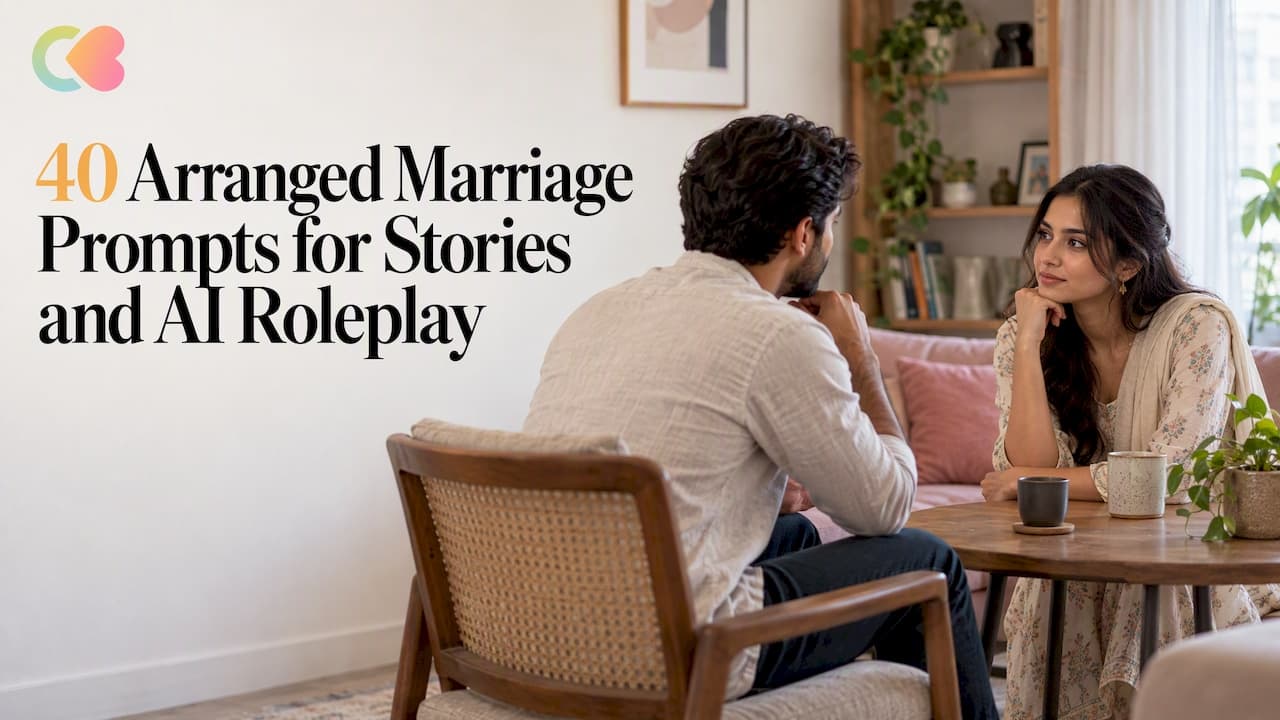
The best arranged marriage prompts give two people a contract they did not choose, a reason they cannot walk away, and a secret that makes staying harder than it looks. Below you will find 40 original prompts grouped by setting, plus a short method for turning any of them into a long-running story or an AI roleplay that does not stall by the third scene. Every character in these prompts is an adult.
TL;DR
- Arranged marriage works because it removes the easy exit. Romance writing guides group it with forced proximity for that reason: if either character can leave, the scenes stop generating friction.
- A strong prompt names the contract, the stakes of breaking it, and one thing each person is hiding.
- Stack a second trope (rivals, a hidden identity, a political plot) so the story has somewhere to go after the first thaw.
- For AI roleplay, set the rules up front: tone, who controls which character, and what the AI should remember.
- Use the prompts below as is, or swap names, eras and settings to make them yours.
Table of Contents
- Why the arranged marriage trope keeps working
- How to write a prompt that holds up
- Royalty and court arranged marriage prompts
- Modern and contemporary prompts
- Fantasy and historical prompts
- Prompts built around a single scene
- Turning a prompt into a story that lasts
- Using arranged marriage prompts in AI roleplay
- Our perspective at Chatr
- Try these prompts with a character of your own
- FAQ
- Sources
Why the arranged marriage trope keeps working
Most romance needs a reason for two people to keep sharing a room. Arranged marriage supplies it in the first line. The characters are bound by family, treaty, debt or tradition, so every breakfast, every public appearance and every night under one roof becomes a scene with built-in pressure.
The Royal Romance prompt collection at Pixelorbyt makes a point worth keeping in mind: the strongest stories in this vein are not about escaping the marriage. They are about two people negotiating a life inside a contract neither signed. That shift changes how you write the opening. Do not ask "how do they get out?" Ask "what do they have to agree on to survive this?"
There are a few standard emotional engines:
- Enemies first. They start hostile, and proximity wears the hostility down.
- Strangers with manners. Both are polite, both are guarded, and the tension is in what is left unsaid.
- One willing, one not. The imbalance creates guilt, pride and slow trust.
- Both willing, for different reasons. Each believes the other is the one being coerced.
How to write a prompt that holds up
Short prompts fail when they describe a situation instead of a problem. "A princess marries a duke" is a situation. "A princess marries a duke whose family is quietly funding the rebels she grew up fighting" is a problem. Before you commit, check four things.
- The contract. Who arranged it, and what does it guarantee? A treaty, an inheritance, a debt, a business merger.
- The cost of leaving. If the answer is "nothing," raise it. War, disgrace, lost land, a sibling's safety.
- The private secret. One thing each person is hiding that would change how the other sees them.
- The public mask. What the couple must perform for the court, the family or the town.
The gap between the public mask and the private truth is where most scenes live. Seasoned writers also recommend stacking tropes, for example arranged marriage plus forced proximity, so the tension does not run out once the initial hostility fades.
Royalty and court arranged marriage prompts
Royal settings give you titles, treaties and an audience. They also answer the royalty romance prompts many readers search for alongside this trope.
- Two neighboring kingdoms end a century of border raids with a wedding. The bride is the general who led the last raid. The groom is the prince who survived it.
- The crown prince is promised to a foreign princess he has never met. She arrives six months early, unannounced, and asks to see the kitchens before the throne room.
- A queen regent arranges her heir's marriage to secure a loan from a rival house. The heir finds the loan agreement in the bride's luggage.
- The princess was supposed to marry the king. The king died on the road. Now she must marry his estranged younger brother, who has publicly renounced the title.
- A royal bride insists on a written marriage contract with eleven clauses. The prince reads clause nine and realizes she has been planning this for years.
- The wedding must happen before the winter council or the treaty lapses. The couple has nine days and no common language except the one they invent.
- A duke's daughter is sent to marry the prince, but her sister is the one the prince has been writing to in secret.
- The prince agrees to the match on one condition: the princess must never ask about the east wing. She asks on the first night.
- A palace tutor is assigned to teach the foreign bride court etiquette. The bride is better at politics than the entire council.
- After the wedding, the couple discovers their marriage was designed to fail, so one house could claim the other's land. They decide to disappoint everyone.
Modern and contemporary prompts
Not every arranged marriage needs a crown. Families, communities and business partners still push matches in the modern world, and the stakes can be just as sharp.
- Two restaurant dynasties merge through marriage. The couple must co-run a flagship location while both families watch the books.
- A widowed landowner asks his neighbor's daughter to marry him to keep a failing vineyard. She agrees, then rewrites the business plan.
- Two families arrange a match through a matchmaker. The couple agree to meet for coffee, compare notes on how to disappoint everyone politely, and accidentally have a good time.
- A tech founder needs a spouse to satisfy an investor clause. A pediatric surgeon needs a visa. Both signed a very specific agreement.
- The couple has three months to decide whether to go through with the wedding. Each week, the families add another condition.
- A small-town mayor's son is matched with the new doctor by two meddling grandmothers. The doctor refuses, and the town starts taking sides.
- They married to save a family ranch. Now the bank wants proof that the marriage is real, and a state inspector is coming for dinner.
- He is the heir to a shipping company. She is the lawyer who drafted his marriage contract. Neither expected to be the other party.
- Two rival bakers are pushed together by a family pact made decades ago. They agree to a six-month trial and a strict no-sabotage rule.
- A couple discovers that their "arranged" match was actually engineered by their best friends, who now have to hide it.
Fantasy and historical prompts
World-building gives you rituals, magic and rules that make the arrangement feel inescapable.
- In a kingdom where marriages are sealed by magical oath, the groom discovers the bride has found a loophole in the wording.
- A dragon-riding clan weds its heir to the daughter of a sea-faring guild. Neither side trusts the other's animals, and both must share a stable.
- The bride is an exiled sorceress offered a pardon if she marries the lord who exiled her.
- A frontier fortress is bound to a distant empire through marriage. The new lord's spouse arrives to find the garrison has not been paid in a year.
- In an alternate Regency, the bride keeps a ledger of every promise the groom makes. The ledger has a surprising number of pages by chapter ten.
- A vampire house seals its truce with a human family. The human bride is the only person at the table who is not afraid.
- A scholar is promised to a warlord to protect the library she tends. She sets one condition: the library comes with her.
- A bride in a gothic estate finds that the groom's first wife left something behind. For ideas in that darker register, the Gothic bride prompt collection at Ink & Insights is a good place to browse.
- The marriage ceremony is a trial. Whoever flinches first loses the alliance. Neither will flinch.
- A prince and his betrothed are both under a curse that breaks only if they stop trying to break it.
Prompts built around a single scene
Sometimes you want a spark, not a plot. These work as opening lines, one-shot scenes or the first message in a roleplay.
- "I read the contract twice. You should know I plan to honor every line."
- "The priest asked if anyone objected. I think we both hoped someone would."
- "You can have the bed. I have slept in worse places than a chair by a fire."
- "My mother told me I would learn to love you. She did not say how long it would take."
- "We are going to be seen together at the ball. Smile like you mean it, and I will do the same."
- "I do not need you to love me. I need you to stop telling the council what I said in private."
- "Your family sent a gift. It is a chess set, and I think it is a message."
- "You walked the whole wedding procession without looking at me once. Why?"
- "Rule one: we do not lie to each other in this room, whatever we say outside it."
- "I found your letters. I would like to talk about the ones you did not send."
Turning a prompt into a story that lasts
A good first scene is easy. The hard part is scene twelve. Here is a simple arc that works for fiction and for roleplay.
- Contract. Establish the arrangement, the stakes and the first impression.
- Boundaries. The couple sets rules: separate rooms, public affection only, no questions about the past.
- Crack. A shared crisis, such as an assassination attempt, a family visit or a failed harvest, forces them to cooperate.
- Secret. One of them is found out. Trust drops below where it started.
- Choice. Now that the contract has been broken in spirit, each must decide whether to stay because they want to, not because they must.
That last step is the payoff. The contract that once trapped them becomes the thing they choose to keep.
Using arranged marriage prompts in AI roleplay
An AI character can play the spouse, the rival suitor, the scheming relative or the narrator. The prompt you paste in is the opening. What follows depends on how clearly you set the ground rules.

Set the frame before the first scene
Write two or three lines before the story begins: the setting, the tone (slow burn, sharp banter, quiet and formal), and what you want the AI to avoid. Research on interactive fiction with language models suggests the best results come when users treat the exchange as a creative performance, using clear tools to guide imaginative output while keeping active oversight of where the story goes.
Agree on memory and authority
Long roleplays drift. Names change, promises vanish, the contract's clauses get forgotten. Experienced roleplayers describe a user covenant: explicit rules about what the AI should remember and who has authority over what. A practical version for an arranged marriage story:
- Restate the contract's key terms every few scenes in one sentence.
- Tell the AI which character you control and which you do not.
- Correct continuity errors in a quick out-of-character note, then return to the scene.
- Do not expect the AI to read your mind. Signal what matters.
Give the AI something to push against
A character who agrees with everything makes a dull spouse. Ask for a guarded character with a goal that conflicts with yours. Instead of "be my loving husband," try "be a prince who believes this marriage is a diplomatic tool and has no intention of falling for it." Resistance is what makes warmth feel earned.
Sample opening message
Setting: the winter palace of a northern kingdom, a week before the wedding. You are Prince Alaric, thirty-one, cautious and dry-witted. I am Lady Maren, twenty-eight, sent to seal a treaty. You think I am a political pawn. I know you are hiding the real state of your treasury. Tone: slow burn, formal at first. Begin with our first private meeting in the library.
That is about sixty words, and it carries a setting, two adults with distinct stances, a secret on each side, a tone and a starting scene.
Our perspective at Chatr

We build for adults who want interactive storytelling with characters they can shape, and arranged marriage is one of the premises we see people reach for because it hands a story its tension immediately. Our view is that the prompt matters less than the collaboration around it. A vivid premise with no rules drifts. A modest premise with clear tone, clear roles and a character who has real wants can run for dozens of scenes.
We also think the genre rewards restraint. The most satisfying arranged marriage stories make you wait: for the first honest conversation, for the first moment someone drops the mask. When you set up a character, give them a reason to hold back, and let your own character earn each concession. And because Chatr is an adults-only space, we keep privacy and safety in the foreground, so you can explore dramatic, romantic scenarios without worrying about who else is in the room.
— Chatr Team
Try these prompts with a character of your own
If you want to play one of these premises rather than write it, you can build a custom character on Chatr and paste in a setting from above, or start from the Chatr home page to browse characters across genres. If you have a photo-based idea for your companion, the create an AI companion page walks through that route. Chatr is available on iOS and Android and is for adults only.
FAQ
What makes a good arranged marriage prompt?
It names the contract, the cost of leaving and a secret each person is keeping. The trope depends on characters who cannot simply walk away, so the exit has to cost something real. Add a public mask the couple must maintain, and you have scenes for a long time.
Can I use these prompts for roleplay as well as writing?
Yes. Paste a prompt as your opening message, add a line about tone and the roles each of you plays, and let the scene develop. The single-scene prompts in the last section work especially well as first messages.
How do I keep an arranged marriage roleplay from stalling?
Stack a second source of conflict, such as a political plot, a rival suitor or a hidden identity, and restate the contract's terms now and then. Stalling usually happens when the first hostility fades and nothing replaces it. Give each character a goal that does not fully align with the other's.
What are some royalty romance prompts?
Start with a treaty, a succession crisis or a foreign bride who arrives early. Prompts 1 to 10 above are all royalty-based and can be adapted: change the kingdoms, ages and stakes to suit your story. Keep both leads adults and give them different reasons for agreeing to the match.
Do arranged marriage stories have to be enemies to lovers?
No. Strangers with good manners, two willing partners with hidden motives, or allies who distrust the families around them all work. Pick the starting dynamic that gives you the most interesting first conversation.
Sources
- Romance Tropes: My Guide to Using Familiar Patterns Well (Squibler)
- Royal Romance Writing Prompts: 28 Ideas With Real Stakes (Pixelorbyt)
- 70 Gothic Bride Writing Prompts (Ink & Insights)
- Purposefully Induced Psychosis (PIP): Embracing Hallucination as Imagination in Large Language Models (arXiv)
- The Quiet Contract & User Covenant (David J. Friedman)