
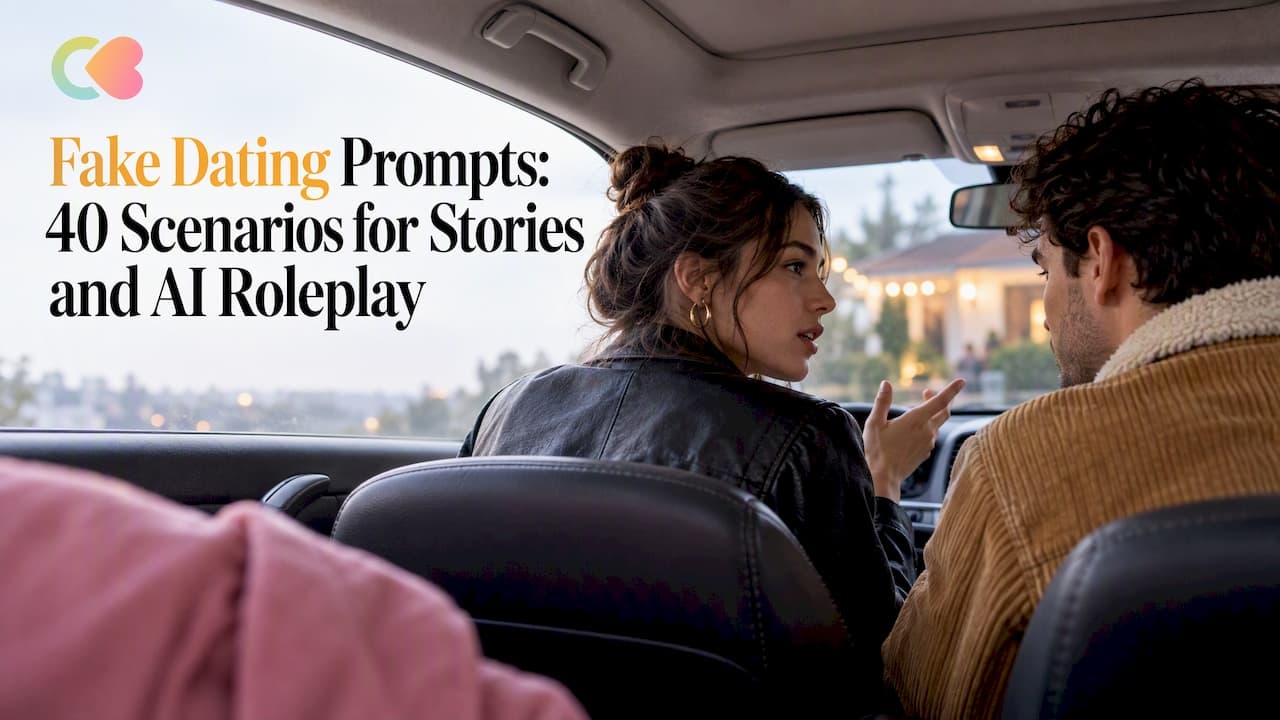
The best fake dating prompts do three things: they give two people a reason to pretend, an audience to fool, and a date when the act is supposed to end. Below are 40 ready-to-use scenarios sorted by motive. After them comes a short method for turning any of them into a scene, a story or an interactive chat with an AI character.
These work for fiction writers, for fans who enjoy the trope, and for adults who like roleplay. They are for adults only. Everything here assumes fictional characters and consenting adult themes.
TL;DR
- A prompt works when it names a motive, an audience and an exit clause. Without all three, the pretense has nothing to push against.
- The fun is the gap between the act and the real feeling, so plant moments where the performance slips.
- For AI roleplay, put the backstory in your first message and restate it when the chat drifts. Keep each decision to a handful of choices.
- Treat AI chat as a private creative space, and check a platform's privacy practices before you share anything personal.
- Below you will find 40 prompts grouped by motive, with a worked example.
Table of Contents
- What makes a fake dating premise believable
- Prompts for family and social pressure
- Prompts for work and reputation
- Prompts for protection and safety
- Prompts for money, bets and contracts
- Prompts for jealousy and second chances
- Prompts that start in a digital space
- A worked example: from prompt to scene
- Using fake dating prompts with an AI character
- Perspective: why we think fake dating works so well as roleplay
- Privacy: what to check before you start
- Build your own fake dating character
- Common ways fake dating stories fall apart
- FAQ
- Sources
What makes a fake dating premise believable
A fake relationship is a promise to the reader: the performance will end up revealing something true. Writer's Digest quotes author Andie J. Christopher on this point. The satisfaction comes from the distance between the fake and the real, not from the act itself.
To get there, the premise needs a reason that ordinary dating can't solve. Squibler's breakdown of the trope says a believable setup needs a glaring reason, clear consequences if the pair is found out, a specific duration, an audience that must be convinced, and an exit clause that says when the pretense ends. That is a useful checklist for any prompt.
The trope is old. Write for Harlequin notes that it has been around at least as long as Shakespeare and keeps being revived in books and movies. Readers know the shape, so your job is the specifics.
Use this quick test on any prompt before you start:
- Motive: Why can't they just date, or just say no?
- Audience: Who has to believe it?
- Cost of failure: What happens if the act collapses?
- Clock: When does it end, and who decides?
- Crack: Where does the real feeling show through?
Prompts for family and social pressure
These are the classics. The audience is close, nosy and hard to escape, which keeps the pretending going in every scene.
- Your character's sister is getting married in three weeks, and their ex is the best man. They arrive with a "partner" they met yesterday.
- A grandmother's health is failing, and her last wish is to see her grandchild settled. A friend agrees to play the part for one holiday weekend.
- A family reunion has a running bet on who stays single the longest. Two cousins' friends team up to win the pot.
- A character's parents keep setting them up with strangers. They bring a roommate to dinner and announce a long-standing relationship.
- The pair must share a childhood bedroom at a holiday gathering, and the "we've been together for months" story has too many details to remember.
- A wedding invitation says "plus one required," and the only person free that weekend is the rival from the next office.
- A character's small hometown has a long memory. One staged date at the diner turns into a town-wide story.
- Two people agree to attend each other's family events for a year, with a written list of who will be asked what.
Prompts for work and reputation
The stakes here are professional, which makes discovery costly and gives the couple a reason to keep going even when it gets uncomfortable.
- A candidate for promotion is told the firm prefers "stable, settled" leaders. A colleague offers to be the stable partner at the next gala.
- A chef's restaurant gets a profile in a magazine, and the writer assumes the chef's business partner is their spouse. Correcting it would sink the feature.
- A politician's campaign manager hires an actor for the spouse role. The actor turns out to be better at it than anyone expected.
- Two rival authors are photographed laughing together at a conference. Their publishers decide the rumor is worth more than the truth.
- A character is stuck at a company retreat where partners are invited. They bring the one person who knows how to charm the boss.
- A visa, a lease or an insurance form assumes a relationship that doesn't exist. Two friends try to keep the story straight under questioning. (Keep it fictional, since real paperwork fraud is a serious crime.)
- A streamer's audience wants a romance arc. Their co-host agrees to stage one for a season.
- A new manager discovers the "couple" on their team has been fake for two years, and each has a different reason to keep it going.
Prompts for protection and safety
These start with a small lie that becomes a bigger one. The tone can be funny or tense.
- A character's last date went badly, and now they suspect they're being followed. A stranger at the cafe agrees to act like a partner until the person leaves.
- A bodyguard has to pose as a boyfriend at a high-profile event. The client keeps changing the rules.
- A persistent admirer won't take no for an answer. A coworker volunteers to be the "taken" partner, with a plan to end it quietly.
- A character is hiding from an old life. A new neighbor's offhand cover story, "we're together," becomes the shield.
- A witness has to relocate and pose as a couple with the person assigned to keep them safe.
- A traveler is stranded in a small town where outsiders are treated with suspicion. A local offers a couple's cover story and a spare room.
Prompts for money, bets and contracts
When rules are written down, the story becomes about which ones get broken first.
- A will leaves a house to whichever grandchild is married first. Two cousins' friends sign a short-term contract to claim it.
- A bet in a group chat: pretend to date for 30 days without anyone guessing. The loser pays for the next vacation.
- A reality show needs a convincing couple. Two contestants are matched by the producers and given scripts they quickly ignore.
- A rental listing requires "couples only," and a friend agrees to share the lease and the story.
- Two entrepreneurs pitch investors as a couple because a founder profile with a family sells better. The pitch goes viral.
- Two characters write a relationship contract with clauses for holidays, public affection and what counts as a breach. The contract is the plot.
- A charity auction offers a "date with a local celebrity." The winner bids to make an ex jealous, and the celebrity asks to be paid in a favor.
Prompts for jealousy and second chances
The audience is one person, and everything is aimed at them.
- Your character's ex posts an engagement photo. Within the hour, they have a new "partner" at the same party.
- Two best friends pretend to date to make someone else jealous, and the jealous party turns out to be the wrong one.
- An old rival turns up at a reunion with a flashy partner. Your character answers with a stranger from the bar.
- A divorced couple has to appear together for a child's milestone event and agrees to act like they're still happy for one day.
- A character's friend group insists on setting them up. They invent a partner so convincing that the friends demand to meet them.
- A long-distance relationship that never really existed gets a visit from curious relatives.
Prompts that start in a digital space
- Two pen pals have been writing as a couple for a story project. A reader asks to meet them in person.
- A dating-profile ghostwriter creates a fake persona for a client, then realizes they're falling for the replies.
- A character rehearses a high-stakes conversation with an AI companion, then has to carry the same act into a real room.
- A group chat roleplay between friends turns into a shared fiction that follows them into real life.
- Two game characters are "married" in a virtual world for a quest bonus, and the players behind them start to feel the story spill over.
A worked example: from prompt to scene
Take prompt 9, the promotion and the gala. Here is how the five-part test turns it into a story.
- Motive: Maya is told leadership at her firm prefers candidates with "stability." She isn't dating anyone.
- Audience: The managing partner and his spouse, who notice everything.
- Cost of failure: The promotion goes to someone else, and Maya's honesty becomes a story the office retells.
- Clock: The gala is on Saturday. The act ends Sunday.
- Crack: Her "partner," Dev, remembers how she takes her coffee, and she hasn't told him.
Now add a small rule sheet: what they will say about how they met, what they won't discuss, and a safe word for "get me out of this conversation." Squibler describes a contract-and-boundary worksheet as part of its approach, and it is a good device on the page too. It gives the characters something to break.
Write the first scene in the car, before they walk in. It's the last honest conversation they'll have all night.
Using fake dating prompts with an AI character
Fake dating suits interactive chat because the premise is already a role. You play one part, and the character plays the other. Researchers studying AI companions describe users acting as both performer and director, treating the chat as a private space to try out versions of themselves. That fits roleplay well, since you set the scene as you act in it.
A few habits make the difference between a flat chat and a good one.
Put the backstory in the first message
Give the character the whole setup at once: who each person is, why the pretense exists, who the audience is, and when it ends. An example opener:
We're pretending to be a couple for my sister's wedding this weekend. We met at a bookstore six months ago, you're a nervous cook, and I'm terrible at lying to my mother. Start in the car outside the venue.
Then restate any detail that matters when the chat gets long. Interactive-fiction projects care about this because character consistency is what keeps a model from forgetting the established story. One open-source dialogue tool notes that its design keeps the focus on character consistency, so the "fake" backstory isn't dropped.
Keep each choice small
Research on branching stories points the same way. The WHAT-IF paper found that having a model generate refined prompts for each story node improved coherence, and that authors often map player input to parameters such as a 1-to-10 intensity scale to shape tone. You can borrow that in plain language: ask your character to keep the flirtation at a "3 out of 10" in public and let it rise only when the two are alone.
Ask for the crack
Tell the character to let the act slip once per scene: a real compliment, a pause that lasts too long, a detail neither of you planned. That is where the story lives.
Perspective: why we think fake dating works so well as roleplay
We built Chatr for adults who want storytelling that reacts to them, and fake dating is one of the cleanest premises for it. The rules are built in. The characters have a reason to stay in character, and the tension between what is said and what is meant gives every reply something to do.

What we see as the real value is control. You choose the character, the scenario, the pace and the boundaries. You can try out a charming version of yourself, rehearse an awkward conversation, or simply enjoy a story with a bit of heat in it. Our platform is adults-only, and we publish policies on prohibited content and underage use because a creative space is only worth having if it is a safe one.
We also think it is worth being honest about what an AI character is. It is a story partner, not a person. Researchers who study these tools say AI companions can ease loneliness, but warn about a feedback loop of virtual care: because the AI can mirror your language to seem caring, it can make avoiding real human vulnerability easier. Our advice is simple. Enjoy the story, and keep room in your life for people.
— Chatr Team
Privacy: what to check before you start
Romantic roleplay can get personal, so privacy matters. A 2026 CHI study found that users of romantic AI platforms often compartmentalize, keeping their AI conversations separate from other digital activity because they worry about surveillance and exposure. The same research notes that many romantic AI apps have drawn serious privacy criticism, and that some have collected highly sensitive data.
Practical habits that follow from that:
- Use a fictional name and details for your character, and keep your real workplace, address and family names out of the chat.
- Read what an app says it collects and stores before you share anything private.
- Don't upload photos of real people without their consent. Our own deep fake policy and third-party consent agreement cover how we handle that.
- Keep roleplay for fiction. If you notice it replacing real contact with friends or partners, talk to someone you trust, or a licensed mental health professional if you are struggling with loneliness.
Build your own fake dating character
If you'd rather make the other half of the pair than hope a chat gets them right, you can on Chatr. You can create your own AI character, start from a single photo, or open the Chatr app and paste in any of the prompts above. Set the scenario, the rules and the exit clause in your first message, and let the story run. Chatr is for adults only, and the app is available on iOS and Android.
Common ways fake dating stories fall apart
- No real obstacle. If the characters could simply tell the truth, readers will wonder why they don't.
- Too much kissing too soon. A quieter version of the trope focuses on the friend-like moments first, before any pining, confessions or physical affection show up, and lets the audience wait for them.
- The ending reveals nothing. The pretense should expose something the characters couldn't say any other way. If it doesn't, the trope is just decoration.
- Inconsistent facts. In prose and in chat, one forgotten detail about how they met breaks the spell. Keep a short fact sheet.
- A clock that never matters. If nothing happens when the exit date arrives, the pretense has no pressure.
FAQ
What is a fake dating prompt?
It is a short story idea or roleplay starter in which two characters pretend to be a couple for a reason, such as pressure from family, a work event or a bet. The best ones include the motive, the audience and an end date. Writers use them for fiction, and roleplayers use them as scene openers.
How do I write a good fake relationship prompt?
Name why they can't just date, who they have to convince, what happens if they're caught, and when the act ends. Then add one detail that will make the pretense slip. That small crack is what turns a setup into a love story.
Can I use fake dating scenarios with an AI character?
Yes. Put the whole backstory in your first message, state the tone you want, and restate key facts if the conversation drifts. Keep your own personal details out of the chat, and remember that the character is a story partner rather than a real person.
Are fake dating prompts only for romance writers?
No. They suit short stories, fan fiction, tabletop and online roleplay, and character practice. Adults also use them to explore different social situations in a private, fictional setting.
Sources
- Squibler: Fake Dating Trope, how to make the premise believable
- Writer's Digest: 5 questions to answer when writing a fake dating romance
- Write for Harlequin: Trope Spotlight, Fake Dating
- Negotiating Digital Identities with AI Companions (arXiv)
- WHAT-IF: Exploring Branching Narratives by Meta-Prompting LLMs (arXiv)
- dialogue-forge (GitHub)
- CHI 2026 research on romantic AI platforms and privacy (ACM)
- Clark University: research on AI companions and the feedback loop of virtual care