
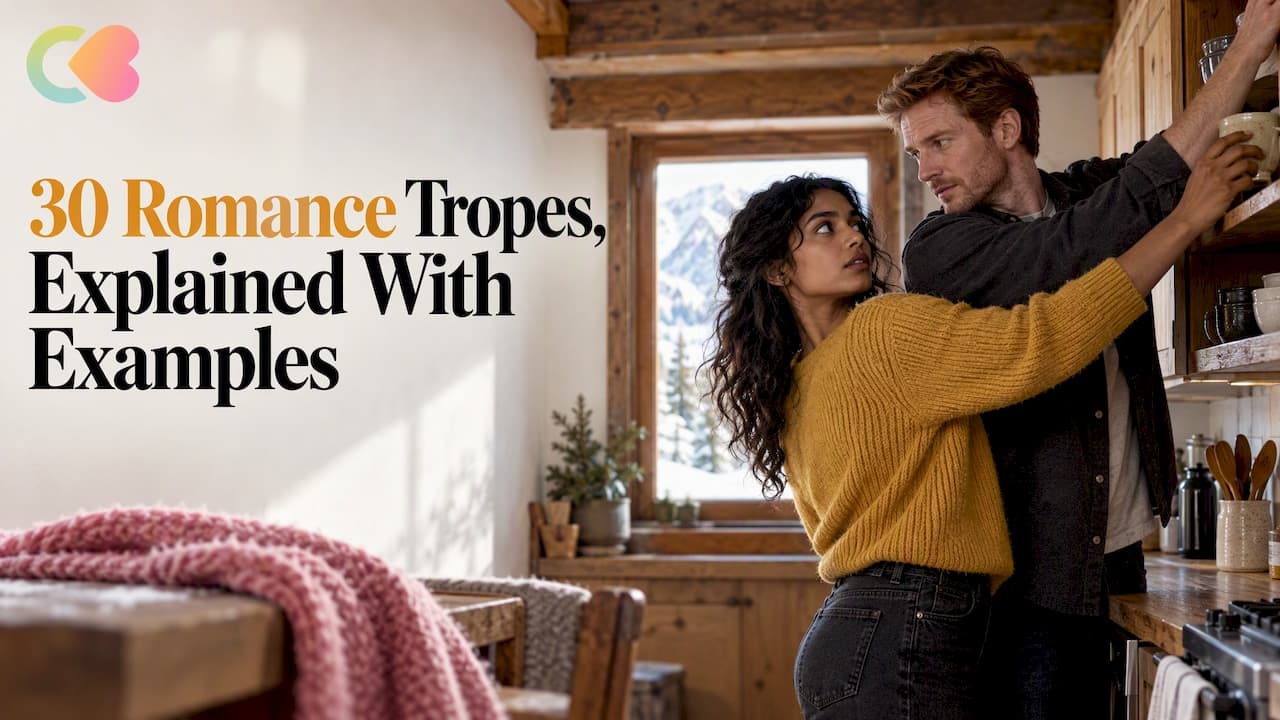
A romance trope is a recurring story pattern or character type that readers recognize and search for by name: enemies to lovers, fake dating, grumpy and sunshine. This list groups 30 of them by the kind of tension they create, so you can find the ones you love, spot the ones you are tired of, and describe your taste in a single phrase.
TL;DR
- Tropes are shortcuts to a feeling. Each one promises a specific kind of emotional tension, which is why readers shop by trope.
- In a January 2025 survey of 2,000 U.S. romance readers, forbidden romance, friends to lovers and enemies to lovers were the three most loved.
- Popular is not the same as universally loved: fake dating is huge online, yet it sits near the bottom of that same survey.
- A trope becomes a cliché only when it replaces character choices. Execution decides everything.
- Whatever the trope, the genre's core contract is a central love story and an optimistic ending.
Table of Contents
- What a trope actually is (and what it is not)
- The rules every trope plays inside
- The most popular romance tropes
- Tropes grouped by the tension they create
- Popular is not the same as loved
- Trope or cliché?
- How to find your tropes
- Our perspective: tropes are better when you can steer them
- Try a trope yourself
- Pairing tropes: combinations that work
- Tropes that rarely work alone
- FAQ
- Sources
What a trope actually is (and what it is not)
A trope is not a plot. It is a pattern inside a plot. "Two rivals are forced to share a cabin" is a premise. "Enemies to lovers" and "forced proximity" are the tropes living inside it.
Genre writers describe tropes as emotional signposts. According to Atmosphere Press's guide to writing romance, they work as promises about the kind of tension you are about to feel, such as trust being built or a barrier being broken down. That is why a reader can pick up a book they know nothing about and still know what the next 300 pages will feel like.
It also explains why the word is not an insult. The same guide describes tropes as blueprints that let readers anchor themselves quickly, so the story can spend its energy on chemistry and conflict instead of setup.
The New York Times took this seriously enough to publish a romance glossary of tropes and themes in February 2026. It mixes structural tropes such as enemies to lovers and forced proximity with character types such as the cinnamon roll, and it frames the entries as a way to find the emotional experience a book promises.

The rules every trope plays inside
Before the list, one boundary. Under the standard attributed to the Romance Writers of America, a romance needs two things: a central love story and an emotionally satisfying, optimistic ending, usually called a happily ever after (HEA) or happy for now (HFN). If the love story is only a subplot, the book has romantic elements but is not a romance.
That ending is part of why tropes feel safe to enjoy. You can let two characters hate each other, lie to each other or marry for convenience, because the genre has already promised the payoff. Writers describe this as emotional justice: characters who take emotional risks are rewarded.
Not everyone agrees on how rigid that should be. Recent debate has centered on whether every book needs the guaranteed ending, and the genre now recognizes romantasy, paranormal romance, dark romance, romantic suspense and romantic comedy as distinct subgenres, each with its own rules for tone and structure.
The most popular romance tropes
These are the ones you will see on covers, in reviews and in recommendation threads.
1. Enemies to lovers
Two people who clash, compete or distrust each other fall in love anyway. The reader expectation is an emotional shift from conflict to trust. It works because animosity creates tension from page one, and the turn feels earned when each character finally sees the other clearly.
2. Friends to lovers
An existing bond deepens into something more. The pleasure is recognition: every earlier scene gets re-read in a new light. The risk for the characters is real, because a confession can cost them the friendship.
3. Forbidden romance
Something stands between the pair: a rule, a rivalry, a job, a family feud. It topped the January 2025 reader survey at 45%, according to Romance Nerds' write-up of the results. The appeal is stakes. Every stolen moment costs something.
4. Second chance
Two people who once loved each other meet again, older and a little scarred. The question is not "will they like each other?" but "what changed, and is it enough?" Childhood sweethearts is a close cousin.
5. Fake dating or fake relationship
Two people pretend to be a couple for a wedding, a job or a family. It builds tension through forced closeness and performed affection that slowly stops being a performance. It is a good example of a polarizing trope, covered below.
6. Forced proximity
A snowstorm, a shared hotel room, a road trip, a cabin. Walls disappear when nobody can leave. It pairs naturally with enemies to lovers and fake dating.
7. Grumpy and sunshine
One character is guarded and prickly, the other warm and relentlessly cheerful. Both can be changed by the other, which is the heart of the pairing.
8. Slow burn
The emotional payoff is delayed on purpose. Slow burn is less a plot than a pacing promise: expect looks, near misses and restraint before the release.
Tropes grouped by the tension they create
If "popular" is not helping, shop by feeling instead. Here is the longer list, sorted by what the trope does to the story.
Rivalry and conflict
- Rivals to lovers: competition at work, in a contest or in a kitchen turns into respect, then more.
- Enemies with a shared goal: a truce for a common mission, with the truce eroding fast.
- Bad boy and good girl (or the reverse): opposite reputations and a mutual pull neither wants to admit.
- Hate at first sight: a bad first meeting that sets the scoreboard to zero.
Arrangements and contracts
- Marriage of convenience: a legal union for practical reasons, with feelings arriving uninvited.
- Arranged marriage: a match made by others, and the question of whether love can follow.
- Contract relationship: terms and conditions, then a clause nobody planned for.
- Already married: the story begins after the vows, not before.
Friendship and history
- Best friend's sibling: loyalty to one person collides with attraction to another.
- Childhood friends: a long history, shared jokes and a lot to lose.
- Pen pals or long-distance: intimacy built through words before faces.
- Reunion at a hometown: returning home with unfinished business.
Character dynamics
- Opposites attract: different values, same gravitational pull.
- Cinnamon roll: a gentle, kind character who is quietly the strongest person in the room.
- Age gap: a difference in life stage that drives the conflict.
- Afraid to commit: a character with a reason for running, and a partner who is patient.
Secrets and surprises
- Secret identity: one lover hides who they really are, and the reveal is the reckoning.
- Mistaken identity: the wrong assumption that makes the first meeting a comedy or a catastrophe.
- Hidden baby or surprise pregnancy: a secret with life-long consequences.
- Love triangle: divided affection and a choice that hurts someone.
Worlds and settings
- Small town: a tight community where everyone has opinions.
- Workplace or boss and employee: attraction under professional pressure.
- Royal romance: duty against desire, with a crown for stakes.
- Fantasy and paranormal: magic, monsters or immortality complicating the pairing.
- Holiday romance: a deadline built into the calendar, from Christmas to a summer fling.
- Dystopian or sci-fi romance: love under pressure from a world that does not allow it.
The New York Times glossary above also lists more specific entries, including brother's best friend, arranged marriage, age gap, gothic romance and dystopian romance, if you want the full A to Z.
Popular is not the same as loved
This is the part most lists skip. Tropes that dominate BookTok are not always the ones readers rank highest when asked directly.
In the same January 2025 survey, the least-loved tropes were love triangles at 23%, office romances at 22% and fake dating at 21%. Fake dating is everywhere online, yet it ranks near the bottom. The likely reading, as the survey's analysis suggests, is that these tropes are polarizing: readers either adore them or are worn out by how often they appear.
Three takeaways:
- Do not treat frequency as approval. A trope can be everywhere and still divide a room.
- Know your own split. Many readers love forced proximity but skip love triangles, or adore slow burn but dislike secrets.
- Combinations matter more than single tropes. Fake dating plus forced proximity plus grumpy and sunshine is a different experience from any one of them alone.
Trope or cliché?
The line is execution. A trope is a foundation. A cliché is what you get when the trope stands in for decisions the characters should be making. One French writing guide puts it this way: skilled authors use the trope as a base and then subvert it with unexpected emotional reversals or a fresh context.
In practice, you can test any trope scene with three questions:
- Would these two specific people do this, or would any two people?
- Does the obstacle come from who the characters are, or from a convenient misunderstanding?
- Does the resolution cost something, or does it arrive for free?
If the answers are "these two," "who they are" and "it costs something," the trope is doing its job, however familiar it is.
How to find your tropes
If you read or write romance, naming your preferences saves time. Here is a simple method.
- List the last five stories you loved. Include books, shows, films, even games.
- Write the moment you remember most from each. Not the plot, the moment: a confession in the rain, a first reluctant laugh.
- Match each moment to a trope above. Patterns show up fast. You may discover that your favorites are all friendship-based, or all about restraint.
- List two you avoid. Knowing your dealbreakers is as useful as knowing your favorites.
- Try one combination you have not read. A familiar trope in an unfamiliar setting is often where the best stories hide.
Our perspective: tropes are better when you can steer them
We build an adults-only platform for interactive storytelling and roleplay, so we think about tropes from a different angle than most lists do. In a book, a trope is something you choose by reading the back cover. In interactive fiction, it is something you can shape as the story unfolds.
That changes what matters. The same enemies-to-lovers setup can be a slow, bruising rivalry or a playful, banter-heavy one, depending on the character you are talking to and the choices you make. A trope gives the scene its emotional shape. Personality, history and your own replies give it life.

Two things we hold to. First, the genre's contract is worth respecting even when the format is experimental: the reader's trust in an emotional payoff is what makes the earlier tension enjoyable, and a story that ignores it risks losing that trust. Second, adults should be able to explore this kind of storytelling in an environment that takes privacy and safety seriously. That is why Chatr is built for adults only, with customizable characters and scenarios rather than one-size-fits-all content.
If you are curious how a trope feels when you are in the story rather than reading it, try picking one from this list and building a character around it.
— Chatr Team
Try a trope yourself
If one of the tropes above caught your eye, you can build a character around it. With Create Your AI Girl, you design a companion and take the story where you want it to go, from slow-burn banter to a rivalry that turns into something else. Chatr is for adults only and is available on iOS and Android, and you can explore everything else on the Chatr homepage.
Pairing tropes: combinations that work
Single tropes are the ingredients. Combinations are the recipe. A few pairings that show up again and again, and why they work:
| Combination | What it produces |
|---|---|
| Enemies to lovers + forced proximity | Constant friction in a shared space, with trust building by inches |
| Fake dating + grumpy and sunshine | Performed affection that one partner resists and the other overplays |
| Friends to lovers + slow burn | A long, quiet build where every glance rewrites the history |
| Second chance + small town | Old wounds in a place where everyone remembers what happened |
| Forbidden romance + secret identity | Double stakes: the rule and the lie |
Atmosphere Press's guide offers a useful shorthand for the building blocks: fake dating pairs forced proximity with tension, and slow burn promises a gradual emotional payoff. Once you see tropes as feelings, stacking them becomes intuitive.
Tropes that rarely work alone
Some patterns need a partner to avoid feeling flat.
- Love triangle: it needs a real dilemma, not a straw rival. Without that, readers sense the outcome and the tension collapses.
- Secret baby: it needs a believable reason for the secrecy, or readers lose sympathy.
- Misunderstanding plots: they need characters who would plausibly not just talk. If one honest sentence would end the conflict, readers notice.
These are the ones that sit lowest in reader favor, which fits the polarizing pattern described earlier.
FAQ
What are the top 10 romance tropes?
Going by reader surveys and BookTok, the usual leaders are enemies to lovers, friends to lovers, forbidden romance, fake dating, forced proximity, grumpy and sunshine, slow burn and second chance. Add love triangles and marriage of convenience and you have a solid ten. Rankings shift by platform and by who is answering.
What are the most overused romance tropes?
There is no official ranking, but the least-loved tropes in the January 2025 U.S. survey were love triangles, office romances and fake dating. Overuse is about saturation more than quality. A familiar trope that is written with fresh character choices rarely feels tired.
What is the difference between a trope and a cliché?
A trope is a recurring pattern readers recognize and enjoy. A cliché is a trope used passively, in place of character-driven decisions. The same setup can be either, depending on how well it is executed.
Does every romance need a happy ending?
Under the Romance Writers of America standard, a romance needs a central love story and an optimistic ending, either happily ever after or happy for now. Some subgenres and readers push on that rule, and the debate is ongoing. Stories that skip the payoff are usually described as love stories rather than romances.
Sources
- Romance Tropes List: 30 Tropes Explained, Romance Nerds
- Writing Romance: A Guide for Authors, Atmosphere Press
- Romance Glossary: An A-Z Guide of Tropes and Themes, The New York Times
- Not Every Romance Needs an HEA, Whitney A. Foster
- Romance Novels Need More Gatekeeping, Not Less, Alyssa Jarrett
- Comment écrire une romance originale, Écrire et être lu